
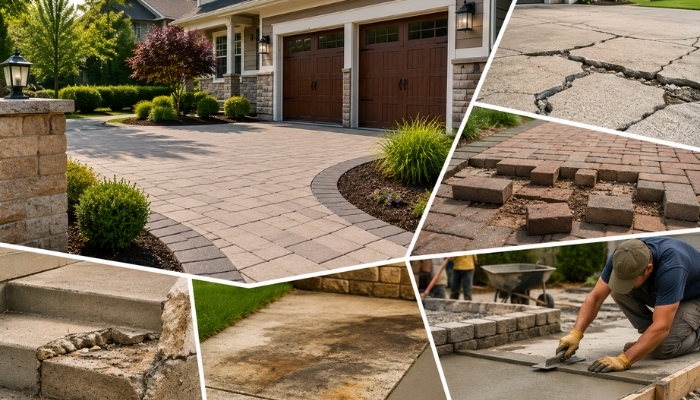
Fairfax homeowners deal with a specific set of outdoor property challenges that most other regions simply don’t face at the same scale. The heavy Marine Clay soil across much of Fairfax County shifts and expands with moisture. The winters bring hard freeze-thaw cycles that stress concrete surfaces repeatedly. The summers are hot and humid enough to accelerate wear on poorly installed materials. As experienced masonry and concrete contractors, JP Companies Inc. sees the same five problems come up again and again at properties across Fairfax, Burke, Reston, McLean, and the surrounding Northern Virginia communities. Here’s exactly what those problems are, why they happen, and how a qualified contractor resolves them properly.
Problem 1: Driveway Cracking and Surface Deterioration
Concrete driveway cracking is the single most common issue Fairfax homeowners report, and the root cause is almost always the same inadequate sub-base preparation before the pour. When a contractor skips proper grading, compaction, or lays concrete directly over unstable ground, the slab has nothing solid to sit on. As Fairfax’s clay-heavy soil expands in wet weather and contracts in dry periods, the slab above it flexes and eventually cracks.
Furthermore, road salt from Northern Virginia’s treated winter roads accelerates this problem significantly. Salt migrates from vehicle tyres onto the driveway surface, triggering rapid freeze-thaw cycles at the concrete’s surface layer that no sealant can fully prevent without proper installation underneath. Professional driveway installation services solve this at the source by excavating to the right depth, compacting a reinforced gravel base, and using air-entrained 4,000 PSI concrete with wire mesh reinforcement that is specifically designed to handle the freeze-thaw stress common across Fairfax County.
The difference between a driveway that cracks in three years and one that lasts thirty years is almost entirely in the preparation, not the concrete itself. Consequently, homeowners who invest in proper installation rarely face repeat problems.
Problem 2: Uneven Surfaces and Drainage Issues
Uneven driveways and pooling water around patios are two sides of the same problem, poor drainage planning. Fairfax receives significant rainfall throughout the year, and properties with flat or back-sloped concrete surfaces end up channeling water toward the house foundation rather than away from it. Over time, this creates erosion under the slab, accelerates surface deterioration, and can cause serious water damage to the property itself.
Professional masonry and concrete contractors address this through precise site grading before any material goes down. A properly installed driveway or patio carries a deliberate slope typically two percent away from the structure that directs water to the correct drainage points. Additionally, in areas with particularly poor natural drainage, contractors integrate French drains or channel drains into the design to manage runoff at the source rather than hoping the slope alone handles it.
This is why surface drainage planning is built into every project estimate not treated as an optional extra. Getting it right the first time prevents far more expensive foundation and structural repairs down the line.
Problem 3: Patio Settling and Sinking
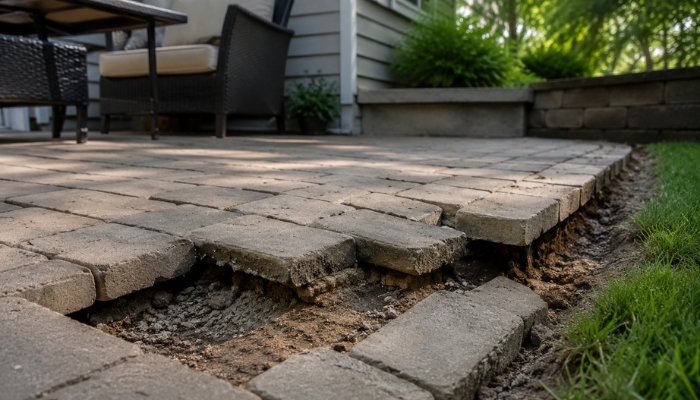
Patio sections that sink or settle unevenly after installation are a direct result of inadequate base compaction. Fairfax’s clay soil is particularly prone to movement, it shrinks in dry conditions and swells when saturated, which means any patio base that wasn’t properly compacted and stabilised will move with the ground beneath it.
Homeowners who invested in custom patio installation through unqualified contractors often find within a few seasons that sections have dropped, joints have opened, and the patio surface is no longer level or safe to walk on. The correct fix and the correct first installation involves excavating to a sufficient depth, installing a compacted aggregate base of appropriate thickness, and in most cases laying a reinforced concrete foundation beneath the paver or stone surface. This engineered approach means the patio stays level and stable regardless of what the soil does beneath it through Fairfax’s seasonal cycles.
Problem 4: HOA Non-Compliance and Permit Violations
Fairfax County has specific requirements for driveway aprons, right-of-way work, and impervious surface coverage limits and many homeowners aren’t aware of them until a project is already underway or complete. Fairfax County’s zoning ordinance limits impervious surface coverage in rear setback areas, and any driveway work that connects to the VDOT right-of-way requires a separate VDOT permit in addition to county approval.
Moreover, homeowners in HOA communities face an additional layer of requirements around approved materials, finishes, and colours. A concrete driveway in a brick-front HOA community may require specific scoring patterns or border details to meet community aesthetic standards. Experienced masonry and concrete contractors handle all permitting coordination including Fairfax County, VDOT, and HOA submission requirements before a single tool touches your property. This protects homeowners from costly stop-work orders, fines, or the expense of undoing non-compliant work.
Problem 5: Spalling and Surface Damage from Winter Exposure
Spalling the flaking or chipping of the concrete surface layer appears most commonly after a Fairfax property’s first winter following installation. The cause is almost always the same: road salt exposure. Even homeowners who never personally apply de-icing chemicals to their driveways or patios bring road salt home on their vehicle tyres from treated public roads throughout Northern Virginia.
As a result, that salt migrates onto the concrete surface and creates a destructive chemical freeze-thaw process that damages the top layer of the slab. Products marketed as “concrete-safe” ice melters do not prevent this, they simply change which chemical compound triggers the same reaction. The correct approach is threefold: proper concrete mix design during installation, a quality penetrating sealer applied before the first winter, and an honest conversation with your contractor about realistic winter care expectations before the project is complete.
Contractors who skip the sealing recommendation or use a lower-grade concrete mix to reduce costs leave homeowners with spalling problems within the first two to three years well outside a standard warranty period.
JP Companies Inc. Fixes These Problems the Right Way — Call Us Today
If you recognise any of these five problems at your Fairfax property, the right time to address them is before they get worse, not after the next winter makes the damage more extensive. JP Companies Inc. serves homeowners across Fairfax, Burke, Reston, McLean, Annandale, Vienna, and the surrounding Northern Virginia communities with honest assessments, written estimates, and concrete and masonry work built to last. Call us at +1 703-327-7007 or reach out through our contact page to schedule your free on-site estimate.
Frequently Asked Questions
What causes concrete driveways to crack so quickly in Fairfax?
The primary cause is inadequate sub-base preparation. Fairfax’s clay-heavy soil shifts seasonally, and without a properly compacted, reinforced gravel base beneath the slab, the concrete flexes and cracks under that movement. Road salt exposure from Northern Virginia’s treated roads accelerates surface deterioration on top of this.
How do masonry and concrete contractors handle Fairfax County permits?
Experienced contractors manage all permitting directly, including Fairfax County building permits, VDOT right-of-way permits for driveway apron work, and HOA submission requirements where applicable. This prevents homeowners from facing stop-work orders or non-compliance issues after a project is already underway.
Why does my patio sink or settle unevenly after installation?
Settling is caused by insufficient base compaction during installation. Fairfax’s clay soil expands and contracts significantly with moisture changes, and a patio base that wasn’t properly excavated and compacted will move with the ground beneath it. A reinforced concrete sub-base under the paver or stone surface prevents this entirely.
Is spalling covered under a contractor’s warranty?
Spalling that occurs within the first few weeks of installation typically indicates a materials mix issue and is covered under workmanship warranty. Spalling that develops after the first winter is almost always the result of road salt exposure and environmental factors, which fall outside standard warranty coverage. Proper installation and pre-winter sealing are the best protections against it.
How do I know if my Fairfax driveway needs repair or full replacement?
Surface cracks under 1/4 inch that are stable and not growing can often be sealed and maintained. Cracks wider than 1/4 inch, vertical displacement between sections, widespread surface spalling, or significant settling indicate structural issues that require full replacement. An honest on-site assessment from a qualified contractor will give you a clear answer without any pressure to commit.
