
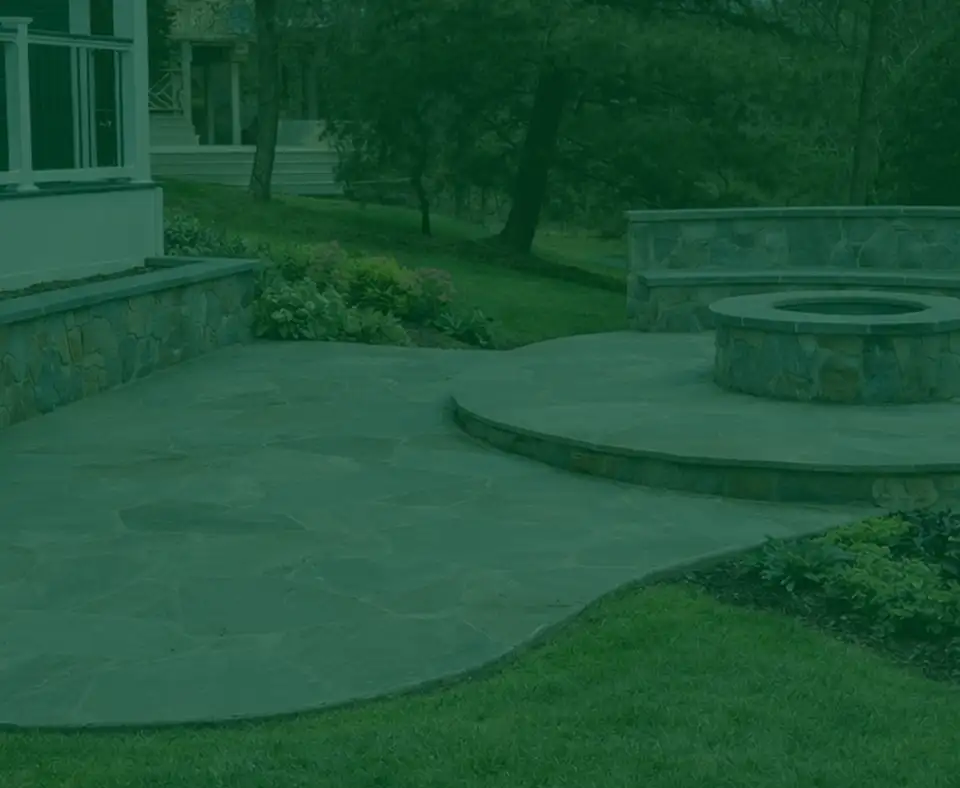
Concrete Patio Finishes
Scored Concrete
Custom-cut joints with a brushed finish for a modern, clean-lined look.
Stamped Concrete
Integral coloring, detailed stamping, saw-cut control joints and a sealed surface that can look like slate, flagstone or wood.
Exposed Aggregate
A surface-retarder technique reveals natural stone for slip resistance.
Built Like Our Driveways
A JP Companies concrete patio is built the same way as our driveways: the same compacted stone base, the same welded wire mesh and the same 4,000 PSI concrete. A patio carries furniture, grills and freeze-thaw winters instead of cars, and the same build keeps it level and sound.
That means 2–4” of compacted 21A or 57 stone, 6” x 6” welded wire mesh and 4” of 4,000 PSI concrete, with control and expansion joints that guide cracking and give the slab room to move with the seasons.
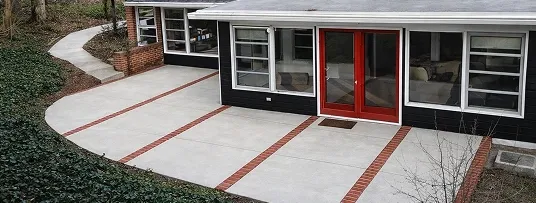
The Step Down From the House
Most back doors sit above the yard, so a concrete patio needs a safe step down from the house.
The usual answer is an engineered concrete landing poured with the patio, with steps down to the slab. If you would rather have wood at the door, a wood step or landing is arranged through trusted subcontractors.
Seating Walls and Fire Pits
A concrete patio pairs well with a stone-faced seating wall and a stone fire pit. See seating walls.
How Long a Patio Takes
A plain concrete patio can be done in a few days on site; stamped finishes, seating walls or a landing at the door add time, and a large project can run to a few weeks.
Caring for a Concrete Patio
In warmer months, lightly mist new concrete for 3–5 minutes twice a day to support proper curing. Keep salt and chemical de-icers off it in winter.
Stamped concrete is sealed as part of the job. Sealing standard concrete is optional; a sealer can become slippery and needs reapplying to stay effective.
How Big Should a Patio Be?
Small Table for Four
About 10 by 10 feet leaves room to pull chairs out.
Table for Six
Plan on about 12 by 12 feet, more with a grill beside it.
Fire Pit and Chairs
A circle about 16 feet across fits a fire pit with a ring of chairs.
Dining and Lounging
Two zones side by side usually means 300 square feet or more.
Stamped, Scored or Exposed Aggregate: Which Finish?
Stamped concrete imitates stone, slate or wood and is sealed for color. Scored concrete adds clean cut lines to a plain slab for a modern look. Exposed aggregate shows the natural stone in the mix and has the most grip underfoot. All three are built on the same base.
Concrete Patio or Paver Patio?
Concrete is one continuous surface: quick to sweep, easy for chairs and grills to roll across, and the lowest upkeep of the patio choices. Pavers and natural stone give more pattern and color. Our article on concrete vs. pavers compares the two in detail.
When Can I Use a New Concrete Patio?
You can walk on new concrete after 24 hours. The concrete keeps curing for weeks after that, which is why misting it in warm weather matters.
Frequently Asked Questions
Do concrete patios crack?
All concrete expands and contracts. Control joints manage that movement; minor hairline cracks may occur in 10–20% of pours.
What is under a JP Companies concrete patio?
A compacted base of 21A or 57 stone, 2–4” deep, under 4” of 4,000 PSI concrete reinforced with 6” x 6” welded wire mesh.
Can you build a landing from my back door?
Yes. We build engineered concrete landings and steps down to the patio, or finish them in stone. A wood option is arranged through trusted subcontractors.
How long does a concrete patio take?
From a few days to a few weeks on site, depending on the size, the finish and what goes with it.
How big should a patio be for a table for six?
About 12 by 12 feet, and more if a grill sits beside it.
When can I walk on a new concrete patio?
You can walk on a new JP Companies concrete patio after 24 hours.
Ready for a New Concrete Patio?
Tell us the size you have in mind and the finish you like, and we will come out, measure the space and talk it through.