Skip to content
JP Companies logo
  • Home
    • About Us
    • Why Choose Us
    • Driveways
    • Concrete
    • Walkways & Steps
      • Concrete Walkways
      • Paver Walkways
      • Stone Walkways
      • Stone Front Steps
    • Patios & Hardscapes
      • Concrete Patios
      • Paver Patios
      • Stone Patios
      • Seating Walls
    • Community & Commercial
  • Projects
  • Our Gallery
    • Understanding Concrete
    • Blog
    • Testimonials

(703) 327-7007

Contact Us

How Long Does a Patio Last? Concrete, Pavers and Natural Stone

  • JP Companies Inc.
  • July 17, 2026
  • 10:09 am
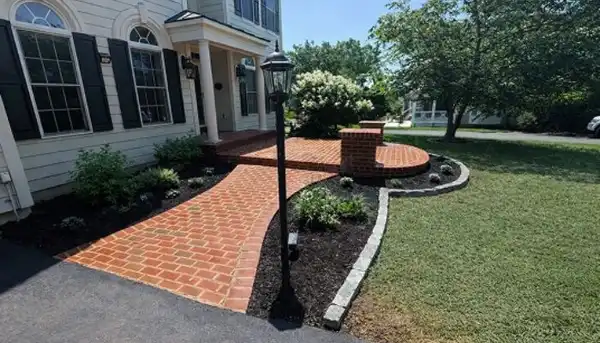
Red brick herringbone walkway from an asphalt driveway to a rounded brick landing and brick pier at the front porch, beside a black lamp post
  1. Home
  2. Blog
  3. How Long Does a Patio Last? Concrete, Pavers and Natural Stone

A well-built patio lasts decades. Concrete, pavers and natural stone can all go twenty-five years or more; what cuts a patio's life short is almost never the material on top. It is water, a weak base and the winters, and all three are decided by how the patio is built.

How Long Does Each Patio Material Last?

  • Concrete. Built like a driveway, on compacted stone with welded wire mesh and 4,000 PSI concrete, a concrete patio lasts as long as a good driveway does: decades. Stamped concrete needs resealing from time to time to keep its color.
  • Pavers. Pavers themselves are very durable, and one damaged paver can be lifted and replaced. Their life depends on the base and the joints staying sound.
  • Natural stone. Flagstone, bluestone and travertine set in mortar on a concrete base can outlast the house; the joints may need repointing after many years.

Light gray concrete paver front patio with a charcoal border, at a covered porch with stone column bases

What Shortens a Patio's Life?

  • Water. A patio that does not slope away from the house holds water against the base and the foundation.
  • A thin base. Soil that was not dug out and replaced with compacted stone settles under the patio.
  • Freeze-thaw. Water that gets into concrete or joints freezes, expands and breaks the surface over time.
  • Salt. De-icers used on a patio by the back door damage concrete and mortar.
  • No edge support. Pavers without a solid edge creep apart.

What Keeps a Patio Going?

  • Sweep it, and rinse it off a couple of times a year.
  • Keep downspouts and sump lines from emptying onto it.
  • Top up polymeric sand in paver joints when it wears low.
  • Use sand, not salt, on icy steps and landings.
  • Fix a small problem, a loose paver or a cracked joint, before water gets under it.

Choosing the Contractor Matters More Than the Material

Since the base decides how long a patio lasts, the most important questions for a contractor are about what you will never see once it is finished:

  1. How deep will the stone base be, and what stone is it?
  2. Will pavers or stone sit on a concrete base, and how is it reinforced?
  3. Which way will the patio slope, and where will the water go?
  4. How is the step down from the house built?
  5. What fills the joints?

A contractor who answers those clearly is planning for the patio to last. A bid that only talks about the surface is a warning sign.

Curved pattern-cut bluestone walkway from the front stoop of a brick house around the lawn to the driveway

How JP Companies Builds a Patio

JP Companies builds concrete patios the same way as its driveways: 2–4” of compacted 21A or 57 stone, 6” x 6” welded wire mesh and 4” of 4,000 PSI concrete. Pavers and natural stone go on a reinforced 4” concrete base, set on a 1” Portland cement bed. See patios and hardscapes.

Frequently Asked Questions

How long does a concrete patio last?

A well-built concrete patio on a compacted stone base can last decades, much like a concrete driveway built the same way.

Do pavers last longer than concrete?

Pavers can last longer, because a damaged paver can be replaced on its own, but only if the base under them stays firm.

What is the most common reason a patio fails early?

Water: a patio that holds water or sits on a base that washes out will settle, crack or shift long before its time.

Related servicePatios & Hardscapes

JP Companies Inc.


Related Articles

  • Hardscape Materials Guide for Northern Virginia Homes

    September 24, 2026

    The right hardscape material for a Northern Virginia home is the one that suits the house, the budget and how much upkeep you want, built on a base that can handle clay soil and freeze-thaw winters. Concrete,…

  • Water Pooling on Your Patio: Causes and Fixes

    August 12, 2026

    Water pools on a patio for one of three reasons: the patio was built without enough slope, part of it has settled, or water from the roof or the yard is running onto it faster than it can run off. A puddle that…

  • Planning a Custom Patio: Size, Material and Layout

    August 4, 2026

    A custom patio starts with one question: what will you do out there? Dining, lounging, a fire pit, a place for the kids to play? The answer decides the size, the shape, the material and what goes with it. Material…

  • How to Plan a Paver or Stone Front Walkway

    October 3, 2026

    A good front walkway starts with how people actually move from the car to the door, then picks a material that suits the house and puts it on a base that will not settle. Get those three right and the details,…

Table of Contents

  1. How Long Does Each Patio Material Last?
  2. What Shortens a Patio's Life?
  3. What Keeps a Patio Going?
  4. Choosing the Contractor Matters More Than the Material
  5. How JP Companies Builds a Patio

(703) 327-7007

Planning a Patio That Lasts?

A patio lasts as long as what is under it. Call (703) 327-7007 or send the form to talk with JP Companies about yours.

Contact Us

Watch Our Latest Jobs

Subscribe on YouTube

  • Video still: Old Asphalt to New Concrete Driveway | Before & After | JP Companies

    Old Asphalt to New Concrete Driveway | Before & After | JP Companies

  • Long new concrete driveway with control joints running past a brick house, with trees and fresh mulch along one side

    Long concrete driveway and flagstone steps at a brick house

  • Wide new concrete driveway with control joints leading to a white one-car garage on a brick house

    Concrete driveway to a one-car garage

  • New concrete driveway with control joints leading to a white carriage-style garage door, with a branch toward the front walk and fall leaves on the lawn

    Concrete driveway and curved flagstone walkway

CONTACT US

Contact us today

Get Free Estimate

Get in Touch

  • 43543 Braddock Rd, Centreville, VA 20120
  • (703) 327-7007
  • info@jpcompaniesinc.com

Which service are you interested in?

Sorry, the form did not go through. Please call us at (703) 327-7007.

JP Companies logo

JP Companies is a family-owned and operated masonry and concrete contractor that has been in business since 2007.

  • VA Class A License # 2705118509
  • MD MHIC License #112231

What We Do

  • Driveways
  • Concrete
  • Walkways & Steps
  • Concrete Walkways
  • Patios & Hardscapes
  • Community & Commercial

Company

  • About Us
  • Why Choose Us
  • Testimonials
  • Projects
  • Our Gallery
  • Blog
  • Understanding Concrete

Get in Touch

  • 43543 Braddock Rd, Centreville, VA 20120
  • (703) 327-7007
  • info@jpcompaniesinc.com
  • Our Google Reviews

Contact Us

Areas We Serve

  • Fairfax County, VA
  • Loudoun County, VA
  • Prince William County, VA
  • Montgomery County, MD
  • See all areas we serve

©2026 JP Companies. All Rights Reserved.

  • Privacy
  • Sitemap
Call Contact Us
JP Companies logo
  • Home
    • About Us
    • Why Choose Us
    • Driveways
    • Concrete
    • Walkways & Steps
      • Concrete Walkways
      • Paver Walkways
      • Stone Walkways
      • Stone Front Steps
    • Patios & Hardscapes
      • Concrete Patios
      • Paver Patios
      • Stone Patios
      • Seating Walls
    • Community & Commercial
  • Projects
  • Our Gallery
    • Understanding Concrete
    • Blog
    • Testimonials

Contact Us