
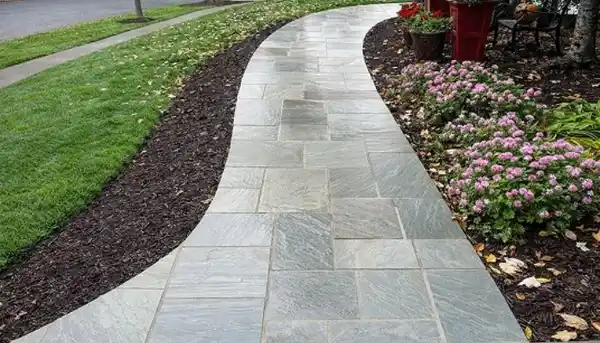
A good front walkway starts with how people actually move from the car to the door, then picks a material that suits the house and puts it on a base that will not settle. Get those three right and the details, borders, lighting and steps, fall into place.
Start With the Route
Watch how people really walk. Guests park in the driveway or on the street, get out of the car and head for the door by the shortest line. A walk that ignores that line ends up with a worn path in the lawn beside it.
A few questions settle the route:
- Do most visitors come from the driveway, the street or both?
- Does the walk need a branch to the side yard or the back?
- Where do the downspouts empty, and can the walk stay clear of them?
- How many steps are there at the door, and is there room for a landing?
Pick a Material That Suits the House
- Concrete gives one smooth surface and pairs with a new concrete driveway.
- Concrete pavers bring pattern and color, from crisp modern slabs to tumbled stones that look aged.
- Brick pavers suit traditional and colonial houses, especially laid in herringbone.
- Natural stone, bluestone, flagstone, travertine or marble, gives the most finished entry.

What Walkway Styles Are Popular Now?
A few looks keep coming up on new front walks in Northern Virginia:
- Large-format pavers with narrow joints for a clean, modern entry.
- Mixed materials, such as a concrete walk with a bluestone border or a stone landing at the door.
- Simple, straight lines on contemporary houses, and gentle curves through planted beds on traditional ones.
- Permeable pavers where water collects near the house.
- Lighting built in from the start rather than added later.
Trends come and go; what lasts is a walk that suits the house and stays level.
Borders and Edges
A border frames the walk and holds the field of pavers in place. A darker paver or a strip of brick along each side looks finished and hides wear at the edges. On a concrete walk, a stone or paver border is an easy way to add character.
Steps and the Landing at the Door
Most front walks end at steps. Plan them with the walk, so the materials match and the landing at the top is deep enough to stand on while the door opens. Stone treads with a slight overhang make each step easy to see.
Lighting
Low-voltage path lights along the walk and lights at the steps make the entry safer after dark. Running the wiring while the walk is being built is far easier than adding it later.
The Base Under It All
Pavers and stone are only as level as what is under them. Pavers laid on sand alone can shift where the ground is soft or wet. Setting them on a reinforced concrete base, with a mortar or sand setting bed and filled joints, keeps the walk level where people step every day.

See walkways and front steps for the walkways JP Companies builds, and paver walkways and stone walkways for each material.