
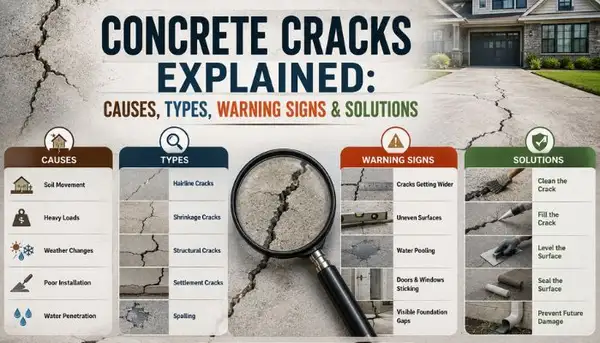
Concrete cracks because it shrinks as it cures and moves with temperature and the ground beneath it. Most cracks are small, harmless and expected. A few are warning signs that something under the slab has changed, and telling the two apart is the whole trick.
Why Does Concrete Crack?
- Shrinkage. Concrete loses water as it cures and gets slightly smaller. That shrinkage causes most early hairline cracks.
- Temperature. A slab expands on hot days and contracts on cold nights, all year long.
- The ground. Clay soil swells when wet and shrinks when dry; a base that washes out leaves the slab unsupported.
- Load. Heavy trucks on a thin or poorly supported slab can break it.

Which Cracks Are Normal?
Hairline cracks, thin enough that a credit card barely fits, are a natural characteristic of concrete. They may appear in 10–20% of pours even when everything is done right. Control joints, the straight lines cut across a slab, exist to give that cracking a planned place to happen; a crack running along the bottom of a joint is the joint doing its job.
Which Cracks Are Warning Signs?
- Cracks that keep widening from one season to the next.
- Offset cracks, where one side sits higher than the other.
- Cracks with a sunken section, especially near downspouts or the edges.
- A web of cracks spreading across a single panel.
These point to movement under the slab: a base that has settled or washed out, or water that is collecting where it should not.
What Are Scaling and Spalling?
Scaling is the flaking of the top layer of concrete; spalling is the same thing in larger chips. Both come from the freeze-thaw cycle: water soaks into the surface, freezes, expands and breaks it from inside. Road salt makes it worse by putting more water into the concrete and lowering the temperature at which it freezes and thaws.
What Can You Do About Cracks?
- Seal hairline cracks with a flexible crack filler if water gets into them.
- Fix the water. Redirect downspouts, clear blocked drains and keep water from standing against the slab.
- Keep salt off, especially for the first few winters.
- Replace failing sections when cracks are offset or widening, because the base is the problem and filler will not fix it.

What Does a Warranty Usually Cover?
Because hairline cracks are a natural characteristic of concrete, warranties generally do not cover them. JP Companies' warranty does not cover cracks under 1/4” in width or vertical displacement, and salt and chemical de-icers void it. Our Understanding Concrete guide explains how to look after new concrete through its first winter.