
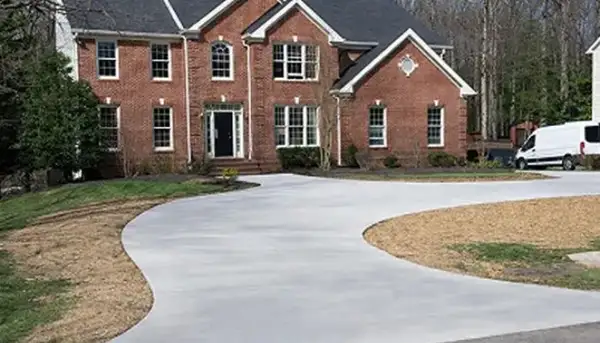
Hiring a concrete or masonry contractor in Virginia comes down to three things: confirm the license, compare estimates that describe the same work, and ask what goes under the surface. A contractor who answers those clearly is one you can hire with confidence; one who cannot is the reason so many driveways and patios have to be redone.
Step 1: Check the License
Contractors in Virginia are licensed by the Department of Professional and Occupational Regulation, DPOR. Any homeowner can look up a contractor's license on the DPOR website and see its class and whether it is current. Class A is the highest class. JP Companies holds Virginia Class A license #2705118509, and Maryland Home Improvement Commission license #112231 for work in Maryland.
Ask for proof of insurance too, and check that the company name on the estimate matches the license.
Step 2: Get Estimates That Can Be Compared
The most common mistake is comparing a total price without comparing the work. Ask every contractor to put these in writing:
- Size and layout of the driveway, walk or patio.
- Tear-out and haul-away of the old surface.
- Base: what stone, and how deep.
- Concrete: thickness and strength (PSI).
- Reinforcement: wire mesh, and how the new slab ties into the garage.
- Joints: where control joints go.
- Finish: broom, stamped, exposed aggregate, pavers or stone.
- Cleanup and how the site is left.
- Warranty: what is covered and what is not.
When two bids list the same things, the price difference means something. When one bid is much lower, it usually leaves something out.

Step 3: Ask What Goes Under It
Most concrete and paver failures start below the surface, so the best questions are about what you will never see once the job is done. How deep is the stone base, and is it compacted? Will pavers or stone sit on a concrete base? Which way will the surface slope, and where does the water go? A craftsman answers those without hesitating.
What Should You Expect During the Job?
A well-run concrete job follows a clear order. Utilities are marked by Miss Utility (811) before any digging. The layout is marked on the ground with you. The old surface is removed and hauled away, the base is prepared and compacted, forms are set, the concrete is poured and finished, and joints are cut. The work area is closed off while the concrete cures, and the site is cleaned up at the end. For a driveway replacement, JP Companies is usually on site one to two days.
Mistakes Homeowners Make
- Choosing on price alone, without comparing what each bid includes.
- Skipping the license check, which takes two minutes on the DPOR website.
- Paying most of the cost up front before work begins.
- Ignoring drainage, then living with water at the door for years.
- Adding pieces later that would have been simpler at the same time, such as the walkway or the steps.
- Not asking about the warranty, especially what it says about hairline cracks and salt.
Why Craftsmanship Shows
Good concrete work looks simple: straight edges, clean joints, an even finish and water that runs off. It is simple because of the steps nobody sees, the compacted base, the reinforcement, the slope and the timing of the finish. Those steps are also what add value to a home: a driveway, walk or patio that still looks right in twenty years.
Services Worth Knowing About
Most homeowners first call about one thing and learn they can fix several at once: a driveway replacement with widening, a new concrete or stone front walk, stone front steps with bluestone treads, a patio with seating walls and a fire pit. See concrete driveway replacement, walkways and front steps and patios and hardscapes.